

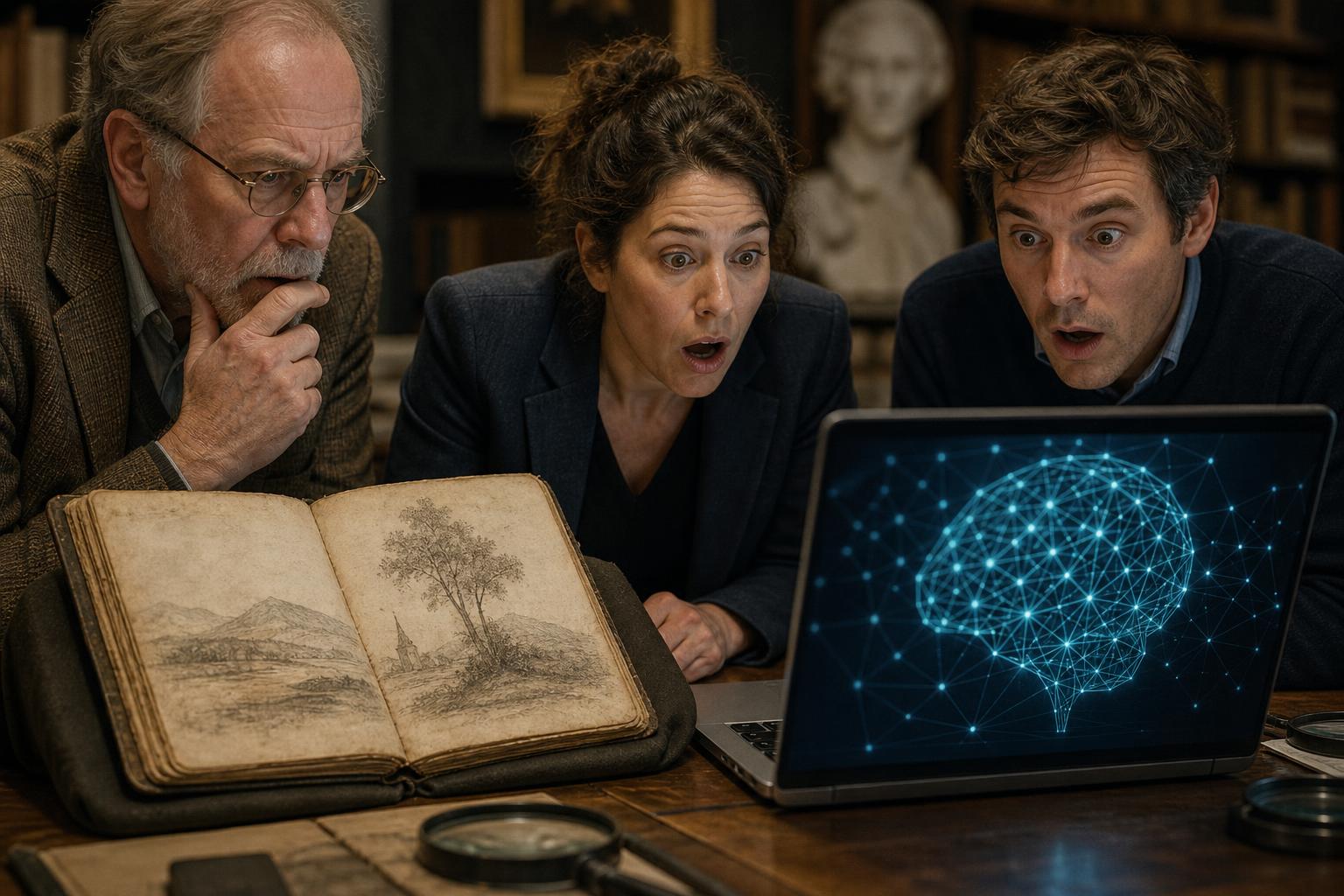
A sketchbook had stayed anonymous for more than 200 years. A historian who had spent years trying to identify its creator says an AI model produced a strong answer in about the time it takes to watch a sitcom.
Mark Humphries, a history professor at Wilfrid Laurier University in Canada, announced on X that the GPT-6.2 Astra model in ChatGPT had named the likely artist behind an unsigned 1808 sketchbook. According to Humphries, it did so in 22 minutes, using only primary and secondary sources that anyone can find on the public web.
The Quick Facts
| Detail | What was reported |
|---|---|
| The object | An anonymous sketchbook from 1808, held at the Beinecke Library at Yale University |
| What it shows | A journey from Montreal to Fort William (on Lake Superior) and back, including places that have since been destroyed |
| The AI | GPT-6.2 Astra, used inside ChatGPT |
| Time taken | 22 minutes, with minimal prompting |
| Proposed artist | Louis-Guy-Charles-Guillaume de Rohan-Chabot, vicomte de Chabot (1780–1875) |
| Key supporting document | A little-known microfilmed diary of Chabot’s trip, held in Special Collections at Cleveland State University |
Why This Puzzle Was So Hard
The sketchbook is unusual, but the route it records was not. Humphries explains that the path was a common one. Without already knowing the traveler’s name, he says, “it is almost impossible to know where to start looking.” That is why the book stayed unattributed for so long.
The clues were thin. Only four images in the book carry both a date and a label. By Humphries’ estimate, the artist could have been any one of several thousand people. He says he had spent many hours over the years trying to solve the mystery without success.
How the AI Approached It
Humphries says Astra worked on the problem from both ends at once. It started with the few facts that can be drawn from the 1808 journey in the sketchbook. It also drew on the large body of surviving information about British North America in that period, and it worked toward a match between the two.
The model settled on Chabot, a minor French aristocrat who spent most of 1808 in Canada as a British Army officer. It also proposed a way to test the idea: order copies of a microfilmed diary from Chabot’s trip, which the AI had found as well.
Humphries says his own role was close to that of a research assistant. He requested copies of the paper documents the AI said it needed. He had included a couple of suggestions in his prompt, but these turned out to be false leads, and the AI did nearly all of the work itself. He also acknowledges that ChatGPT works as a “black box,” so its inner workings are not fully clear.
How the Hypothesis Was Checked
The test was done by a person, with scans ordered from the microfilm. Humphries reports that when they arrived, several things lined up:
- The handwriting in the diary matched the captions in the sketchbook.
- The itinerary fit the few dated drawings in the book.
- A direct statement: on 18 June 1808, after Chabot’s canoe reached Fort St. Joseph, he wrote “I took a sketch.” He then described the exact view of the fort that appears in a matching drawing.
Humphries calls that last detail the kind of conclusive evidence historians rarely get.
A Second Discovery: The Diary Itself
The diary turned out to be significant on its own. According to Humphries:
- It had been mentioned just once, in a dissertation footnote in a completely different area of history.
- It was unknown to fur trade historians and Canadian historians.
- It is long and detailed, at about 162 notebook pages.
- It came with additional documents, including excerpts from long-destroyed North West Company papers, journals and letters.
He says new document finds are exceedingly rare in a well-studied field like fur trade history, and that other leading experts he consulted were equally surprised by both finds.
What Humphries Says It Means
Humphries calls the result “a significant historical discovery.” He says it required the AI to read through sources, build a hypothesis from limited evidence, and argue a case. “It would be unlikely that a human could replicate what it did,” he says.
He also draws a comparison with mathematics. About eleven months earlier, he notes, large language models began solving the first Erdős problems. He says that over the past year, these systems have gone from learning to read handwriting, to beginning to think historically, to mastering the undergraduate essay, and finally to making small but real contributions to human knowledge more or less autonomously. In his view, the process of research and discovery seen in verifiable fields like math is starting to spread to less clear-cut fields like history. “The trajectory seems clear,” he writes.
A Balanced Reading
The story is impressive, but a few points are worth keeping in mind:
- It is one historian’s account. The details come from Humphries’ own post and the coverage of it. The reports reviewed here do not describe any wider scholarly review of the attribution.
- The AI did not work alone. A human supplied the prompt, ordered the microfilm scans, and compared the handwriting and itinerary. That verification step is what turned the AI’s hypothesis into a confirmed one.
- Humphries himself offers a plain explanation. He says Astra’s path to the find can technically be described as the product of stronger search capabilities, though he stresses that it carried out the investigation from beginning to end.
- The method has limits. The approach depends on the evidence existing and being accessible. As long as it is, the report suggests, AI agents can be very good at finding it.
Why It Matters Beyond One Sketchbook
The practical lesson is not that AI has replaced historians. It is that these tools may be able to connect scattered fragments, such as a footnote in one place and a microfilm reel in another, far faster than a person can. Archives are full of such fragments. If AI models can reliably point researchers toward them, other long-standing mysteries could be revisited.
For now, this case offers a clear example. A question that stumped a specialist for years was answered with a testable lead in 22 minutes, and the lead was then confirmed by documents that a human went and obtained.
